

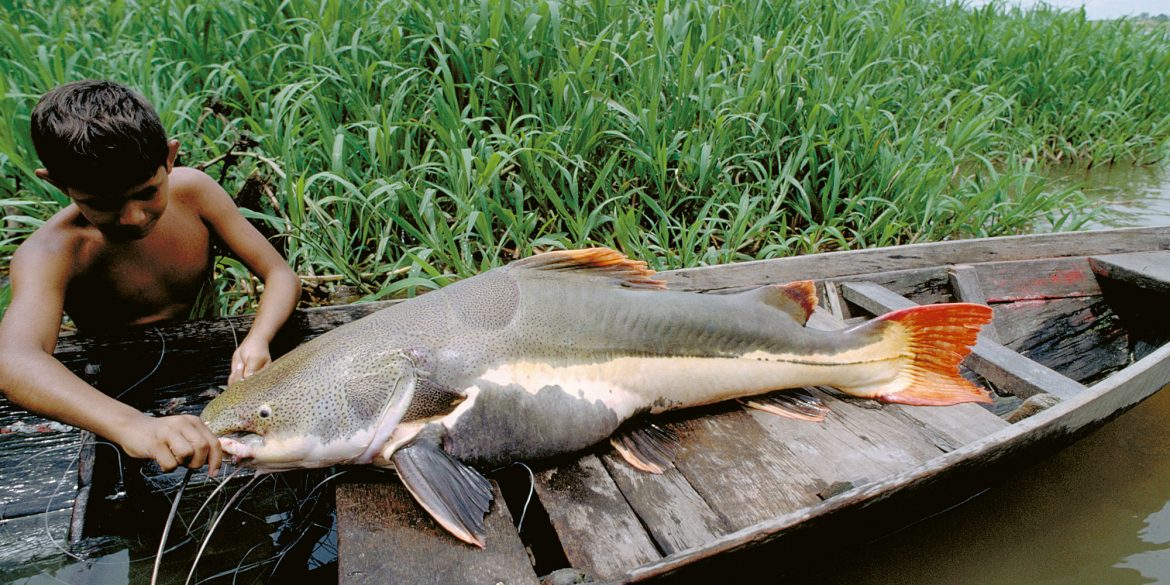
Categoria de comprimento: Large (>100 cm)
Nível trópico: Omnivore
Padrão migratório: Medium Distance (100-1,000 km)
Período de desova: Low + Rising
Mercado de exportação: National (outside Amazon)
Status do mercado: Second class
Distribuição de capturas:
Pirarara potential yield was estimated to be almost 900 tons. Four fishery regions accounted for 93% of its potential yield: Brazilian-Colombian-Peruvian Border (42%), Central Amazon (21%), Lower Amazon (17%) and Peruvian Amazon (13%).
Notas de História Natural:
The pirarara is an omnivorous species that feeds heavily on fleshy fruits in flooded forests but also takes crabs and fish, the last especially during the low water period. The species is not captured in large schools but it is still unclear whether it migrates since young fish have never been found in blackwater and clearwater rivers. It is possible that pirarara migrate down blackwater and clearwater tributaries to spawn in whitewater rivers.

Distribution of pirarara catch. Source: Barthem, R., Goulding, M. 2007. An unexpected ecosystem: the Amazon as revealed by fisheries. Missouri Botanical Garden Press.
| Brazil | |
| Cajaro | Phractocephalus hemiliopterus |
| Pirarara | Phractocephalus hemiliopterus |
| Ouarara | Phractocephalus hemiliopterus |
| Paruaruima | Phractocephalus hemiliopterus |
| Colombia | |
| Pirarara | Phractocephalus hemiliopterus |
| Guacamayo | Phractocephalus hemiliopterus |
| Músico | Phractocephalus hemiliopterus |
| Cajaro | Phractocephalus hemiliopterus |
| Ecuador | |
| Guacamayo-bagre | Phractocephalus hemiliopterus |
| Peru | |
| Pez-torre | Phractocephalus hemiliopterus |
| Bigorilo | Phractocephalus hemiliopterus |